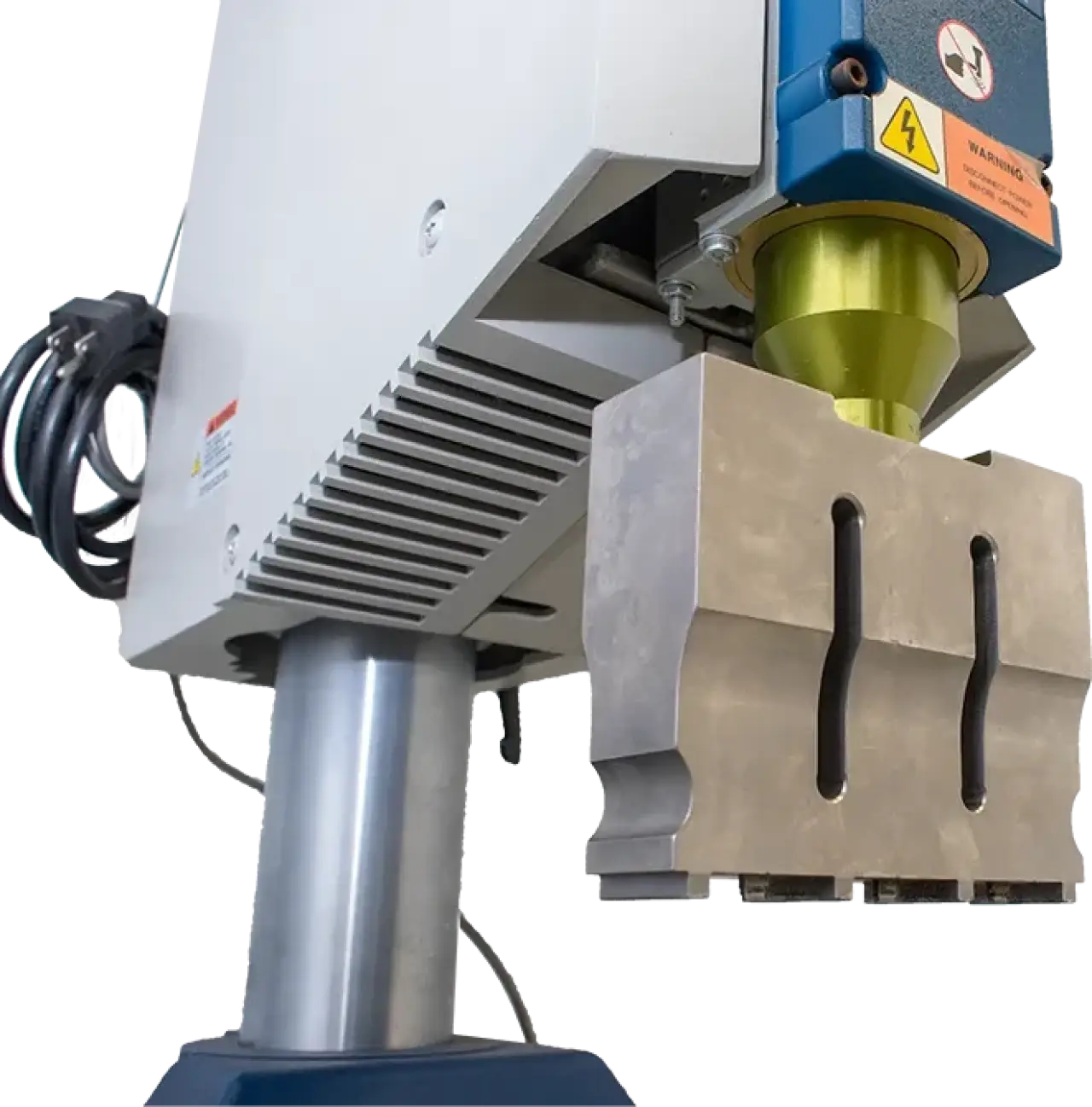

Don't scrap your failing equipment. We provide expert Branson Ultrasonic Converter repair services to restore your transducers to factory-spec performance. Our repair process ensures your system maintains peak resonance and power output at a fraction of the cost of buying new.
Expert Repair for 20kHz Branson Models:
-
Model 902J Repair: Specialist restoration for the 900-series 20kHz workhorse. We address ceramic fatigue and electrode wear to bring your 901, 910, or 920 system back online.
-
Model 922JA Repair: Precision servicing for high-efficiency 900-series automated converters. We focus on maintaining the exact amplitude required for high-speed production.
-
Model CR20 Repair: Technical repair for 20kHz "Circular" style transducers used in 2000, 2000X, and DCX series power supplies.
-
Model CJ20 Repair: Comprehensive overhaul for the industry-standard 2000-series sealed converter. We ensure the internal seals and piezoelectric stacks are perfectly tuned for 2000X and IW+ systems.
30kHz & 40kHz Specialist Repair Services:
We also provide precision repair for high-frequency Branson systems used in delicate medical and electronic assembly:
-
30kHz Models: Expert repair for Branson 3000 Series and DCX30 converters, including the 302 and 332 models.
-
40kHz Models: Comprehensive servicing for Branson 4TR, 4TJ, 4TP, and 4TH converters. These high-frequency units require specialized tuning to maintain the tight tolerances needed for precision welding.
Troubleshooting Guide: When to Repair Your Branson Converter
If your production line is experiencing the following issues, your 902J, 922JA, CR20, CJ20, or 40kHz converter likely requires professional repair:
1. Frequency Overload (OL) Errors
If your power supply displays an "Overload" or "Frequency Error," the converter’s internal piezoelectric ceramics may be cracked or out of tune. Repairing the stack can clear these faults.
2. Excessive Heat or Noise
A converter that becomes hot to the touch or emits a high-pitched "whistling" sound is losing efficiency. This is often caused by internal component friction or loose mounting studs.
3. Inconsistent Weld Strength
If your parts are failing pull-tests despite having the same settings, the converter may be failing to provide a consistent amplitude. We recalibrate the transducer to ensure uniform energy delivery.
4. Visible Physical Wear
Check the interface surface (the "face") of the converter. If you see pitting, oxidation, or black residue (fretting), the converter needs to be resurfaced and tested to prevent damage to your boosters and horns.
Our Branson Converter Repair Process:
-
Acoustic Impedance Analysis: Testing the unit to find the exact frequency and capacitance.
-
Full Component Level Rebuilds: All converters are fully rebuilt including, new ceramics, new wafers, new wiring, and new studs.
-
Sealing & Insulation: Restoring environmental seals on air-cooled and sealed models.
-
Surface Lapping: Precision machining of the contact face to ensure a flat, high-torque fit.
-
Rigorous Load Testing: Every rebuilt Branson converter is subjected to dynamic load testing, simulating real-world production under maximum duty cycles to ensure it runs as reliably as a new OEM component.
-
1 Year Warranty: All converters have no questions asked 1 year warranty, providing the same peace of mind as a new purchase.